Mission Possible
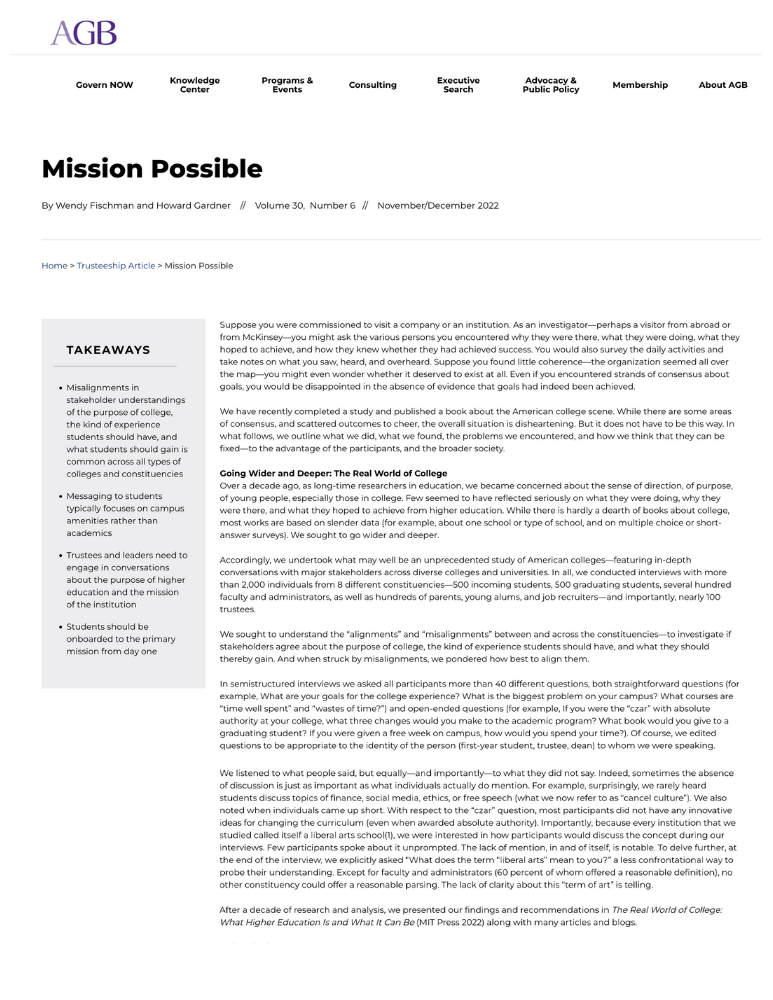
In Mission Possible for Trusteeship Magazine, Wendy Fischman and Howard Gardner present insights from an extensive qualitative study of American higher education based on interviews with over 2,000 stakeholders, including students, parents, faculty, administrators, trustees, young alumni, and job recruiters. The authors explore the degree to which different constituencies align or diverge in their understanding of the purpose of college, the experiences students should have, and the outcomes they should achieve. The study reveals a significant misalignment: students, parents, and trustees commonly view college through a transactional lens focused on credentials and employability, while faculty and administrators are more likely to hold a transformational view that emphasizes intellectual growth and deep learning. Despite many institutions espousing broad liberal arts missions, the concept of mission is often absent from daily practice and discourse. Fischman and Gardner argue that this “mission sprawl” undermines institutional coherence and weakens the ability of colleges to fulfill their higher education aspirations. They propose that institutions—especially those committed to non-vocational liberal education—should identify and clearly articulate a central mission centered on developing students’ capacity for critical thinking, reflection, and meaningful communication, which they term Higher Education Capital (HEDCAP).