
Ways Things Can Be Complex
A guide for organizing one’s understanding of a topic through concept mapping.
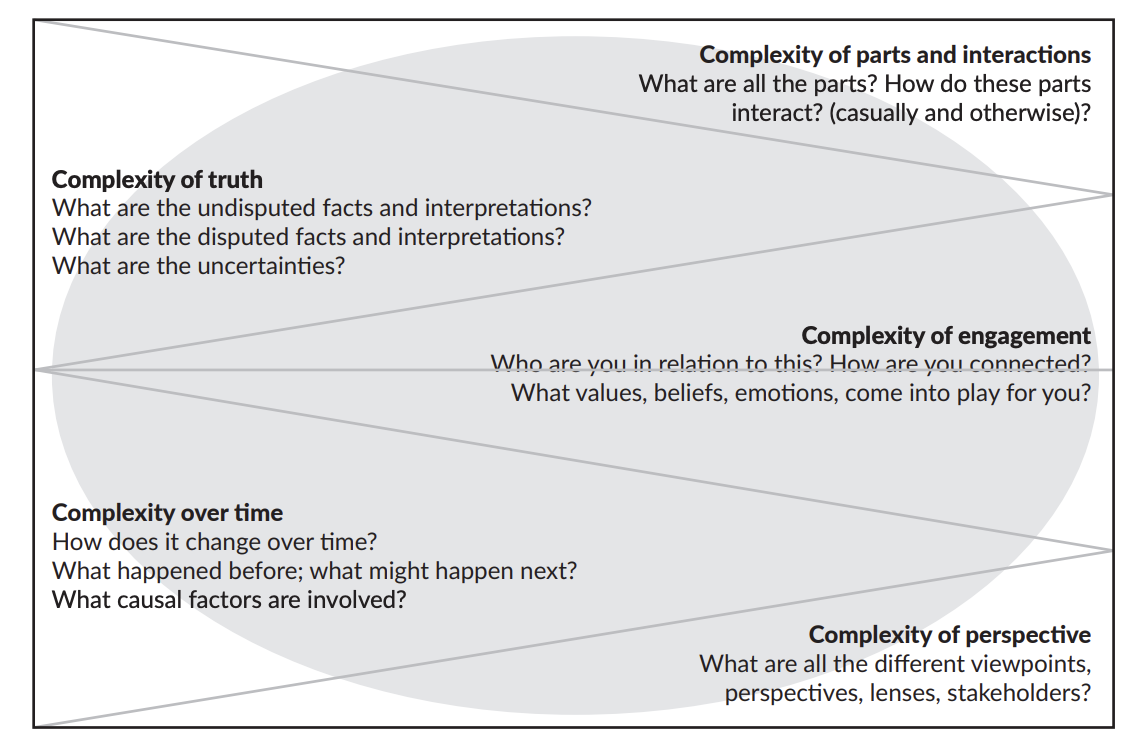
Things can be complex in many ways. In fact, that is often what makes them complex. The diagram on the next page identifies several different types of complexity. Each type is accompanied by a few questions that help point students toward the kind of complexity in question. Not all the categories apply equally well to a single topic. For example, a bicycle can be viewed as a complex object: it has many interacting parts, it may change over time, and so on. But it isn’t really useful to consider the complexity of truth related to a bicycle. A bicycle just is. That is unless you are examining the environmental friendliness of bicycle manufacturing, in which case truth may well be an issue.
The diagram can be useful in several ways:
- Use it to plan an introductory lesson on complexity. Choose a topic or object. Tell or show it to students, and show them the Ways Things can be Complex chart. Ask students to consider each of the categories and explore which kinds of complexity can be uncovered in the topic.
- Use the chart to expand your own ideas about complexity
- Use it to help you think about which types of complexity you particularly want to emphasize in relation to particular topics.
- Use the chart to identify and gauge the quality of students’ thinking: Which kinds of complexity are they exploring? How deeply are they exploring them?
Origins
This thinking routine emerged from the Visible Thinking project. Take a look!
Copyright
© 2019 President and Fellows of Harvard College and Project Zero. This work is licensed under a Creative Commons Attribution-NonCommercial-NoDerivatives 4.0 International License (CC BY-NC-ND). This license allows users to share this work with others, but it cannot be used commercially. To reference this work, please use the following: The “Ways Things Can Be Complex” thinking routine was developed by Project Zero, a research center at the Harvard Graduate School of Education