
Reporter’s Notebook
A routine for separating fact and feeling.
Identify a situation, story, or dilemma for discussion.
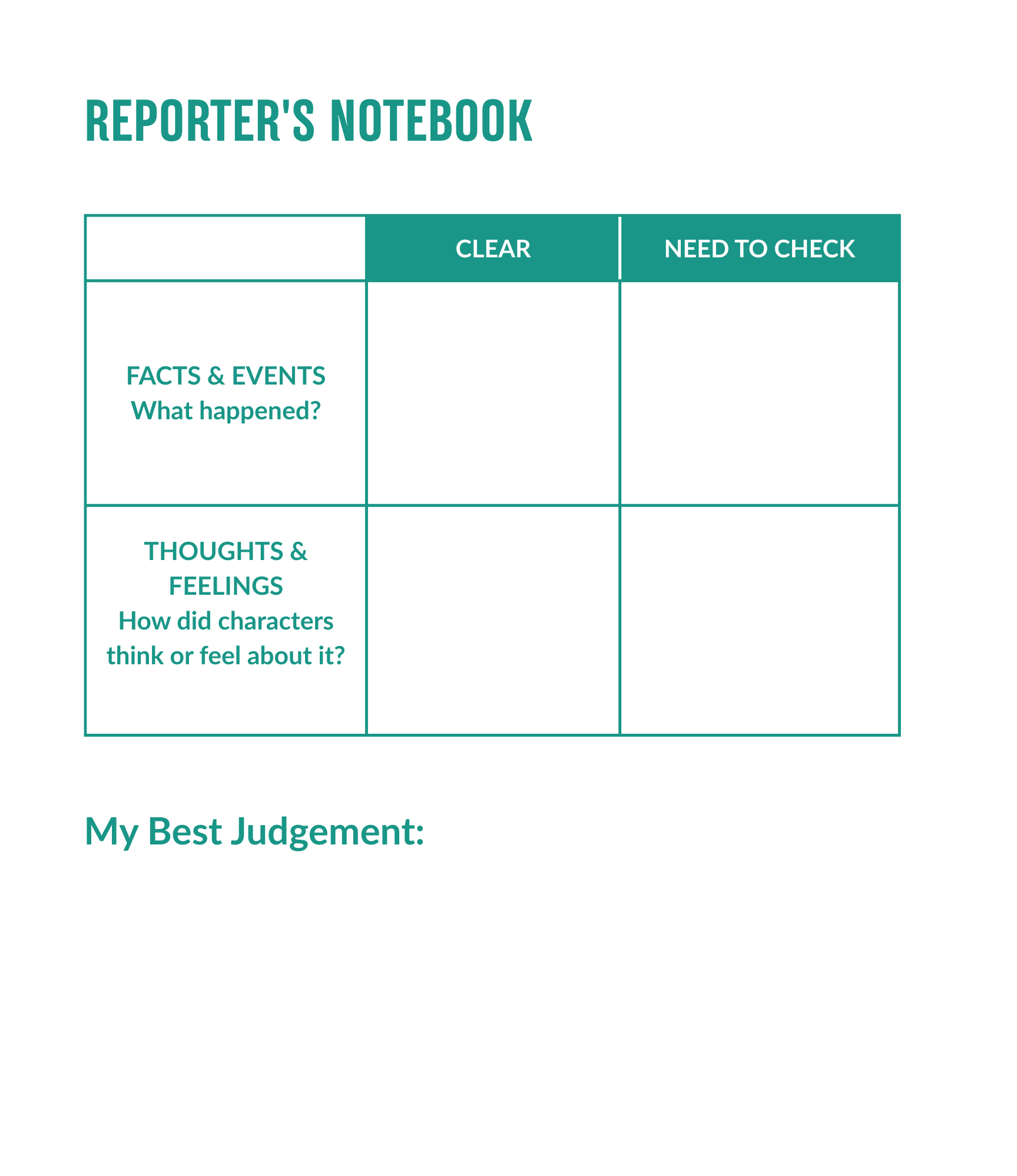
Name the facts and events of the situation.
(What evidence confirms these?)
Identify the thoughts and feelings of the characters/participants in the situation.
(What evidence confirms these?)
Make your best judgment about the situation, based on this information.
PURPOSE
What kind of thinking does this routine encourage?
This routine helps students to distinguish among facts, thoughts, and judgments and to organize ideas and feelings, encouraging perspective-taking.
APPLICATION
When and where can I use it?
Consider using the Reporter’s Notebook routine in many situations: when discussing imagined or real moral dilemmas or topics from history, literature, or science; after reading a chapter or watching a video or performance; or, when inviting students to think about actual events from their own lives. This routine is most useful “mid-investigation,” after some information about a given situation has already been shared and explored. Maybe the topic is growing increasingly more complex as students’ learning advances, or perhaps the topic has generated disagreements among students. Perhaps students are mistaking opinions (either in the texts being examined or in the students’ discussions) for facts. Using this routine can help students deepen their understanding of a topic and clarify for themselves the roots of the complexity or confusion.
LAUNCH
What are some tips for starting and using this routine?
This routine is best introduced in a whole class discussion. Once students understand the routine, they can work independently or in small groups. Ask students to imagine they are newspaper reporters who need to differentiate the facts of a given event from the thoughts and feelings of those involved in the event. The stance of a reporter helps students to clarify issues, including points of agreement and disagreement, by giving them the opportunity to step back from their own perspectives or initial understandings of a given situation. Invite the students to create a reporter’s notebook grid by drawing a 2x2 grid on a piece of paper. Over the two columns on the top, students write “Clear” and “Need to Check.” On the side, they write “Facts & Events” and “Thoughts & Feelings.” Then students consider the event or issue under discussion and list responses in the appropriate portion of the grid. As you listen to students’ conversations, encourage them
Origins
This thinking routine emerged from the Visible Thinking project. Take a look!
Copyright
© 2019 President and Fellows of Harvard College and Project Zero. This work is licensed under a Creative Commons Attribution-NonCommercial-NoDerivatives 4.0 International License (CC BY-NC-ND). This license allows users to share this work with others, but it cannot be used commercially. To reference this work, please use the following: The “Reporter’s Notebook” thinking routine was developed by Project Zero, a research center at the Harvard Graduate School of Education