Outside In
A routine for connecting personal interests to topics in school.
LAUNCH
What are some tips for starting and using this routine?
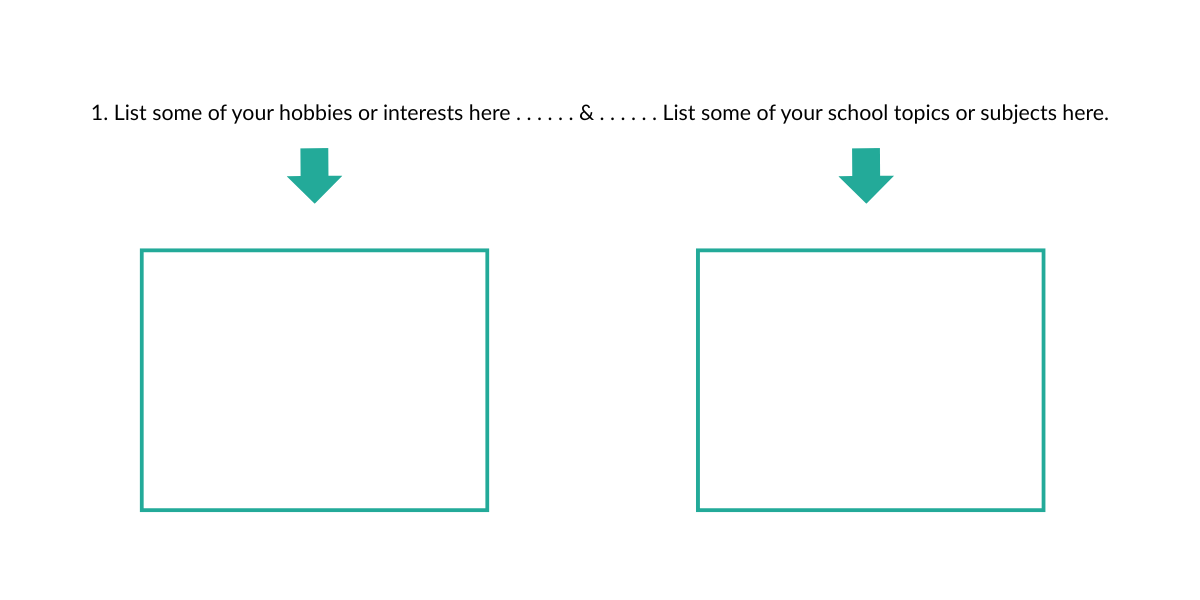
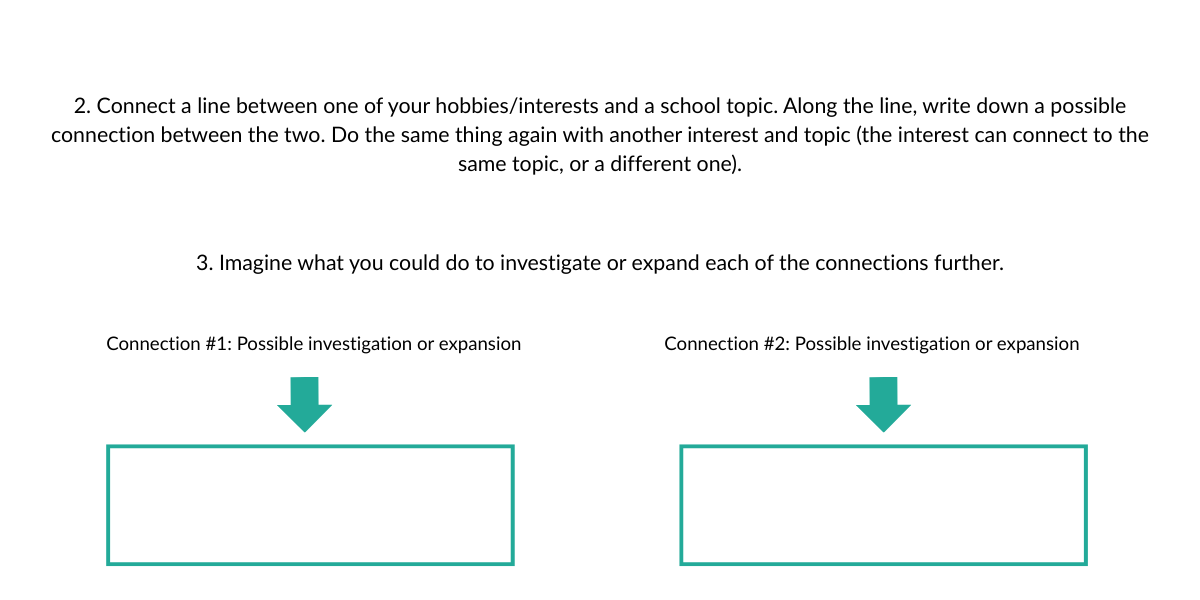
How can I help students make outside-in connections (and should I worry if the connections seem superficial)? At the broadest level, a connection is any type of relationship or association between two or more things. There is plenty of room for creativity, because connections can be metaphorical as well as literal. One way to help students find connections is to suggest that they look for certain types of connections. For example, they can look for connections related to form (e.g., how things are shaped physically or conceptually, what they look like, what things are made out of or what materials they use or involve); structure (e.g., how things are organized, how they work as a system), stories (e.g., the stories things tell or are told about them, or how things evolved over time,); defining ideas (e.g., main themes, definitions, key concepts); learning (e.g., how people learn about them, the learning challenges they involve); and culture (e.g., the customs and traditions people associate with them, the significance they have for groups of people). Don’t worry if students make connections that at first seem broad or superficial. Most connections get more interesting once you spend some time thinking about them, and the ‘imagine’ step of the routine gives students an opportunity to dig into a connection and explore its depth. For example, a student might make a connection between her dance lessons and science class in school by saying that dance involves the human body and the human body is a topic in science. On the face of it, this may seem like quite a broad connection. But, as the answer to the next question illustrates, with a bit of expansion it can become quite interesting.
How can I help students imagine how to investigate the connections they make? A good way to start is to encourage students to brainstorm several questions about their connections. For instance, to continue with the foregoing example about dance, science, and the human body, here are some further questions students could ask. How are different systems of the body involved in dance— for instance the muscular system or the skeletal system? How is dance itself like a body system? What would it be like to create a dance inspired by the firing of neurons in the brain, or by the circulatory system? How does dance affect human health?
What should students do after they use the routine? Should they follow up on their ideas? There are two possible options. One of course is to encourage students to continue to investigate the ideas they came up with. They could do this as a special project, or as part of the regular curriculum. But even if there’s no follow-up, just having students seek and expand on connections is worthwhile in itself. Why? Because knowledge likes to be activated, and students will find it interesting simply to reach for connections. Also, using the routine regularly helps students get in the habit of making connections. Recall the principle mentioned in the introduction to the Portable Knowledge materials: What you learn is what you do. Students who make connections frequently as part of the learning process are much more likely to continue that connection making later on. Moreover, sometimes school-based learning is seen as unconnected to students’ lives outside of school. But learning happens everywhere. By getting in the habit of making connections ‘outside-in,’ students begin to see learning as what it truly is—a lifelong, lifewide endeavor.
Origins
This thinking routine emerged from the PZ Connect project. Take a look!
Copyright
© 2019 President and Fellows of Harvard College and Project Zero. This work is licensed under a Creative Commons Attribution-NonCommercial-NoDerivatives 4.0 International License (CC BY-NC-ND). This license allows users to share this work with others, but it cannot be used commercially. To reference this work, please use the following: The “Outside In” thinking routine was developed by Project Zero, a research center at the Harvard Graduate School of Education