How Next Level Learning Enables A More Powerful Vision for Transfer
Workforce development programs rest on ideas about what human beings are capable of. The first three briefs in this series draw on learning sciences, neuroscience, and cognitive science to introduce a new view of learners as Next Level Learners. The first brief presented learners as agentive, actively shaping the contexts that support their learning. The second expanded this view to emphasize dispositions—developing awareness, abilities, and inclinations that enable effective reasoning. The third brief introduced adaptive expertise, the capacity to think flexibly, repurpose knowledge, and build new connections across domains. This brief extends that vision to explore how these ideas shape a richer understanding of transfer in workforce development.
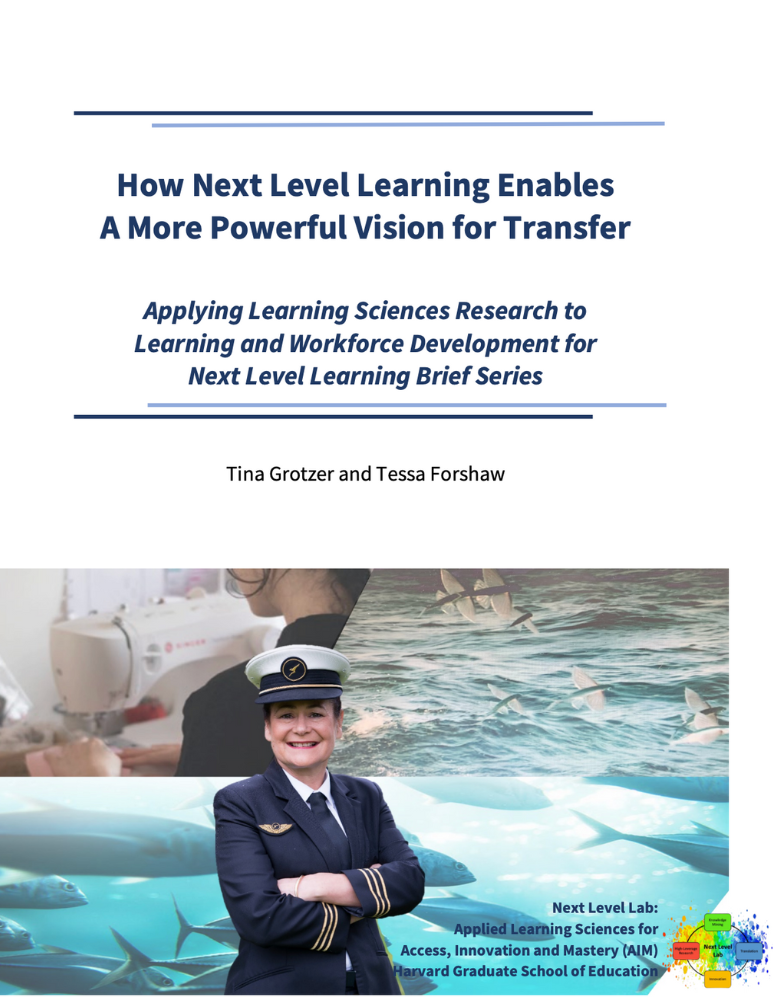
Transfer refers to the ability to apply skills and knowledge from one context to another. It is essential for mobility and inclusion in today’s evolving world of work. Yet, focusing only on moving knowledge between contexts is limited. Building on the broadened, asset based notion of learners outlined earlier, this brief introduces a new model of transfer centered on agentive, dispositional, and adaptive learners. These learners can recognize patterns, adjust to new contexts, and actively shape environments that support their growth. The brief argues that learning and transfer are most powerful when they occur within meaningful contexts—where learners are, metaphorically, “fish in water,” able to draw on and expand what they already know.