Values, Identities, Actions
A routine for exploring some rich civic aspects of works of art.
Take some time to look closely at the work. What do you notice? Make lots of observations.
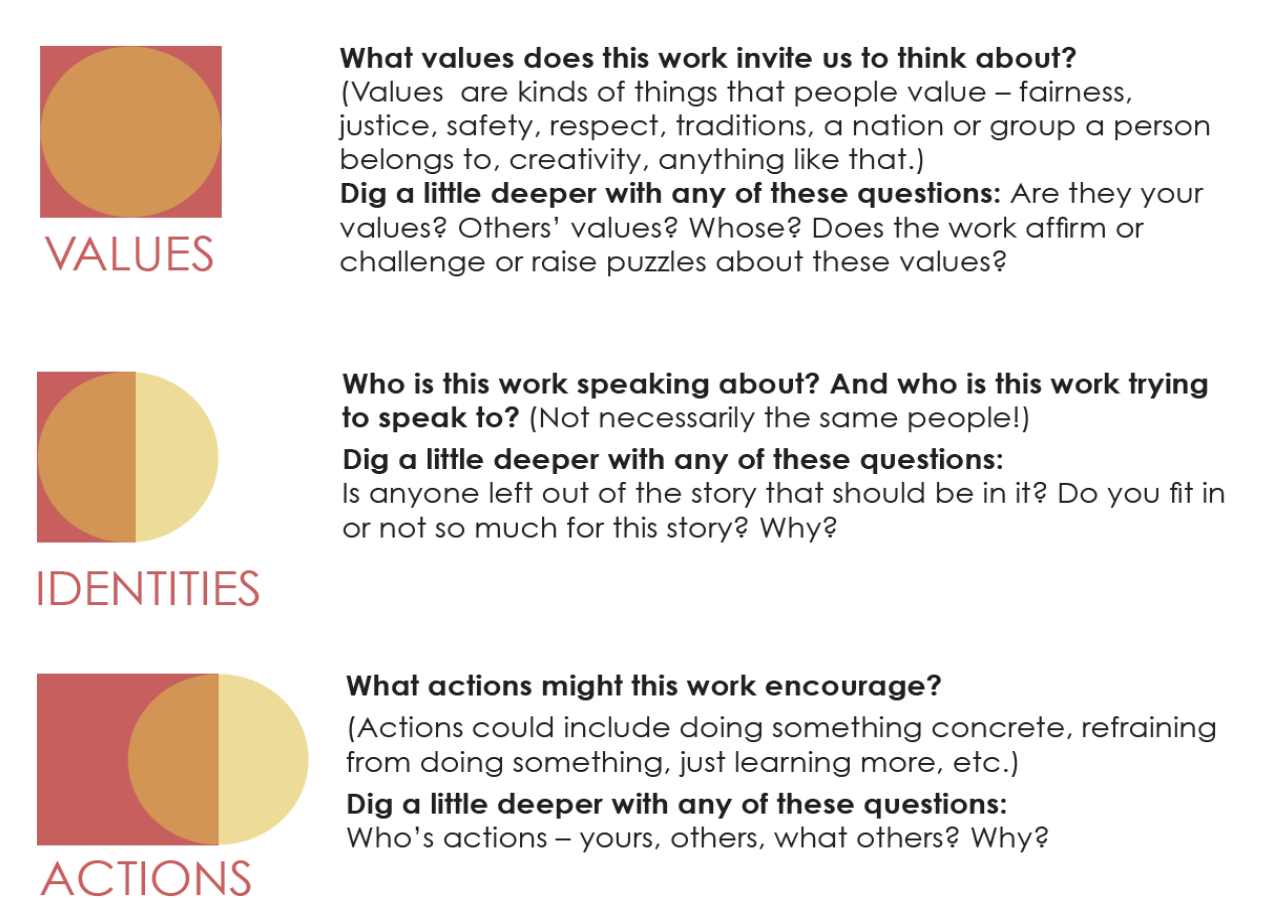
Look back at the work now. Spend a little time. Do you get any ideas that might add to Values, Identities, or Action?
VIA is a relatively straightforward routine for exploring some rich civic aspects of works of art. It is quite easy to facilitate in most settings. Here are a few tips to make the experience a success.
Before You Begin
A key aspect of a good VIA session concerns choice of the work or works. A fertile work for VIA has one or more fairly easily discernible civic themes, where matters of Values, Identities, and Actions invite comment.
Often, such works feature a deliberate civic statement of some sort ... but not always. The work might have been fashioned for other reasons altogether and still happen to invite civic connections. In other words, VIA is not necessarily an attempt to interpret the work as intended by an artist but an attempt to see the work through a civic lens.
You might select works in advance that you feel would support a good conversation. But also, it often plays well simply to say a few words about what makes for a good VIA conversation and turn participants loose in a gallery, or with a book of art, etc., to make their own choices. If students are having difficulty saying something about the art, you might use any of the Viewing Moves or Dialogue Moves to support their discussion.
Facilitating the Routine
Often no direct facilitation is necessary. You can distribute the routine on paper and ask participants individually or in small groups to go through the steps. For a large group talking together, or perhaps for people trying VIA for the first time, it may make sense to lead the participants trough the process. This can be done with a handout or orally.
The top question under each of V, I, and A is the key question. Be sure participants get to that one. As to the “dig a little deeper” questions, there is no need to cover every single one. That’s a lot of conversation! You can pick and choose according to what explorations look most promising for the work of art in question and the participants.
You can make choices with the age of the participants in mind. For younger participants feel free to focus on participants questions and rephrase them if needed. However, be positive minded about what younger participants can tackle. They often have more to say than one might imagine about digging deeper questions. Participants using VIA individually or in small groups often explore VIA more richly if they expect a general conversation involving all participants at the end, where people briefly and informally report in headlines. You can facilitate that conversation.
Origins
This thinking routine emerged from the Arts as Civic Commons project. Take a look!
Copyright
© 2019 President and Fellows of Harvard College and Project Zero. This work is licensed under a Creative Commons Attribution-NonCommercial-NoDerivatives 4.0 International License (CC BY-NC-ND). This license allows users to share this work with others, but it cannot be used commercially. To reference this work, please use the following: The “Values, Identities, Actions” thinking routine was developed by Project Zero, a research center at the Harvard Graduate School of Education