
The Story Routine: Main, Side, Hidden
This routine helps students analyze events and explore documents in more depth by constructing a set of narratives around those events.
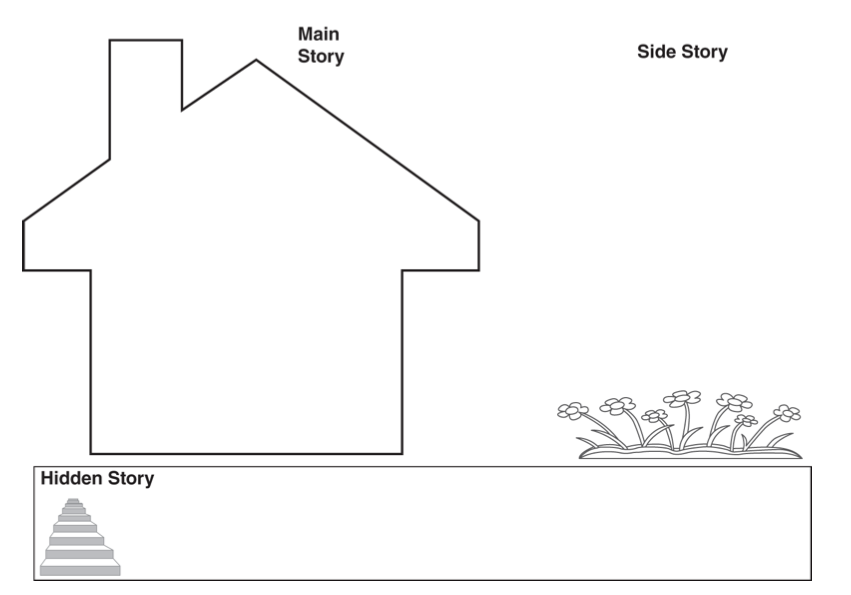
After closely examining the source document or material, respond to the prompts and explain your thinking:
- What is the main or central story being depicted or documented?
- What is the side story (or stories) happening on the sidelines or around the edges? This might not necessarily involve the main characters.
- What is a hidden story—that is, a story that may be obscured, unspoken, or happening below the surface that we aren't readily aware of initially?
BACKGROUND
This thinking routine was originally developed for Densho, a Seattle‐based organization dedicated to preserving, educating, and sharing the story of the World War II-era incarceration of Japanese Americans. Densho educators were looking for new ways to extend learners' understanding beyond the central story of the historical events and to get learners thinking about the deeper issues and implications of those events both for that time period and for today. This kind of thinking was particularly important because many of the documents preserved from that period are propaganda materials that were used to justify the internment to the American people and the world.
PURPOSE
What kind of thinking does this routine encourage?
This routine helps students analyze events and explore documents in more depth by constructing a set of narratives around those events. Learners begin with the main narrative to capture the core or central story being told. Then, by looking for side stories, students are encouraged to identify additional points of view that are present, but which are not the main focus. Looking beneath the surface of events to uncover the hidden story, learners are invited to explore the complexities of the narrative or the situation.
APPLICATION
When and where can I use it?
Source material should embody depth and some degree of complexity. It might be a primary source document from an historical archive, a complex work of art, a news event or photograph, events from a story or novel, a case study, a data set, or even a social problem or situation.
LAUNCH
What are some tips for starting and using this routine?
- Setup. Introduce the source material and invite students to examine it carefully. This could be done individually or in pairs. This slow looking (Tishman 2017) shouldn't be rushed, and students should be explicitly encouraged to take time to notice things that aren't immediately apparent.
- Main. invite students (working individually or in pairs) to identify the main story that captures the central ideas that are most apparent.
- Side. Prompt students to identify possible side stories. What else is going on here around the edges? Who are the other actors that might be contributing to the main story but are not the major players?
- Hidden. Finally, ask students to consider the hidden or untold story. What is not immediately apparent but might nonetheless be important in understanding what is actually happening? What might be obscured or left out, either intentionally or unintentionally?
- Sharing Thinking. Convene a whole class discussion. Often there is agreement regarding the main story, and so this doesn't typically need much discussion. A class will often generate a wide variety of side stories, and students' understanding of the situation can be enhanced by hearing these. As students share, ask them for elaboration, explanation, and evidence. Discuss the hidden stories. It is not uncommon for some students' side stories to be others' hidden stories, and this is fine. You might follow up by asking, “So what is that making you wonder about this situation?” or “Why do you think that story has been hidden?”
Origins
Explore the full PZ Thinking Routine Toolbox at pz.harvard.edu/thinking-routines.
Copyright
© 2020 Ron Ritchhart and Mark Church. All rights reserved. To reference this work, please use the following: The “The Story Routine: Main Side Hidden” thinking routine was developed by Project Zero, a research center at the Harvard Graduate School of Education