See, Think, Me, We
A routine for connecting to the bigger picture.
BEFORE YOU BEGIN
Choose an artwork or image. This routine works well with a wide variety of works, so feel free to be experimental or adventurous in your choice. If you typically use classrooms norms for respectful discussion, you may want to refer to them before you begin: The routine invites learners to make personal connections, so it’s especially important to establish an atmosphere of trust and care.
FACILITATING THE ROUTINE
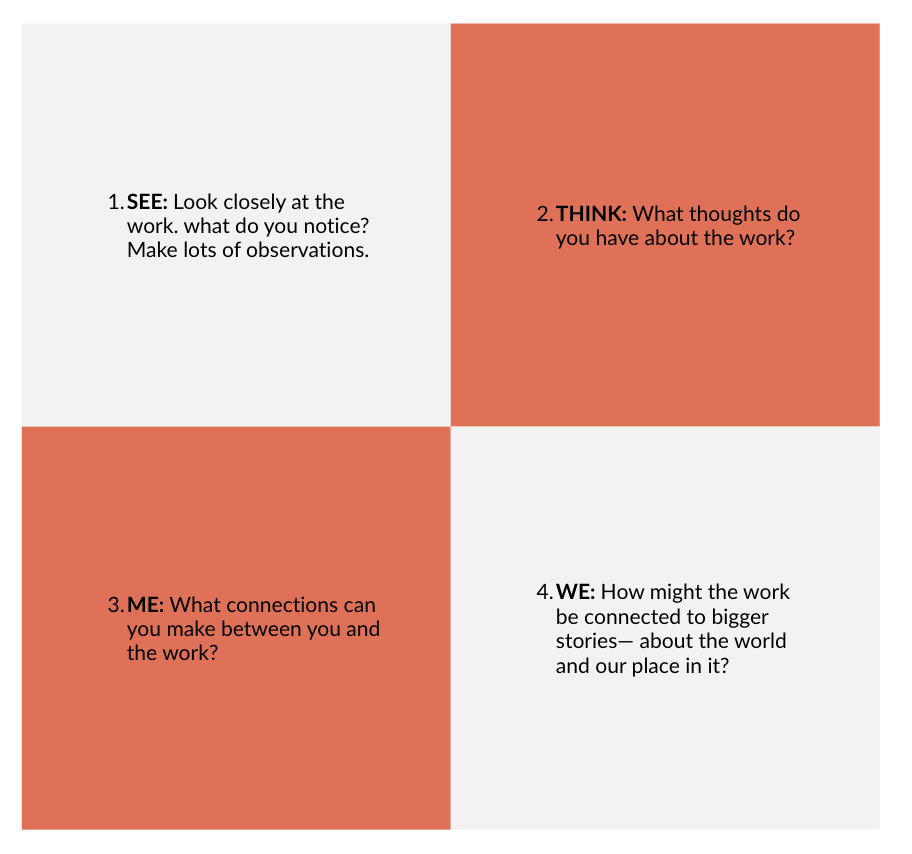
The SEE step encourages close looking. Ask learners to fully describe what they see, and to hold off making interpretations or giving opinions until the THINK step. If you like, deepen the SEE step by using a strategy or two from the Viewing Moves.
The THINK step encourages learners to share thoughts about the work. All thoughts are welcome, but you can give some direction to the step by asking questions such as: What’s going on in the work? What might it mean? What makes you say that?
The ME step asks learners to make personal connections, so it’s a moment when a safe and trusting atmosphere is especially important. You may want to model this step by sharing your own personal response first. If you’re working with a large group, it can be helpful to do this step in pairs or trios. You can also add support to the discussion by using strategies from the Dialogue Moves, such as NAME or STORYTELLING.
By asking for ‘bigger stories,’ the WE step invites learners to reach for connections beyond themselves. One way to help them do this is to ask them to consider how the personal connections they identified in the ME step might connect to larger themes of human experience. This step can be challenging for students. As with the ME step, it can be helpful for you, the facilitator, to model a response by sharing your own reflections.
Origins
This thinking routine emerged from the Arts as Civic Commons project. Take a look!
Copyright
© 2019 President and Fellows of Harvard College and Project Zero. This work is licensed under a Creative Commons Attribution-NonCommercial-NoDerivatives 4.0 International License (CC BY-NC-ND). This license allows users to share this work with others, but it cannot be used commercially. To reference this work, please use the following: The “See, Think, Me, We” thinking routine was developed by Project Zero, a research center at the Harvard Graduate School of Education