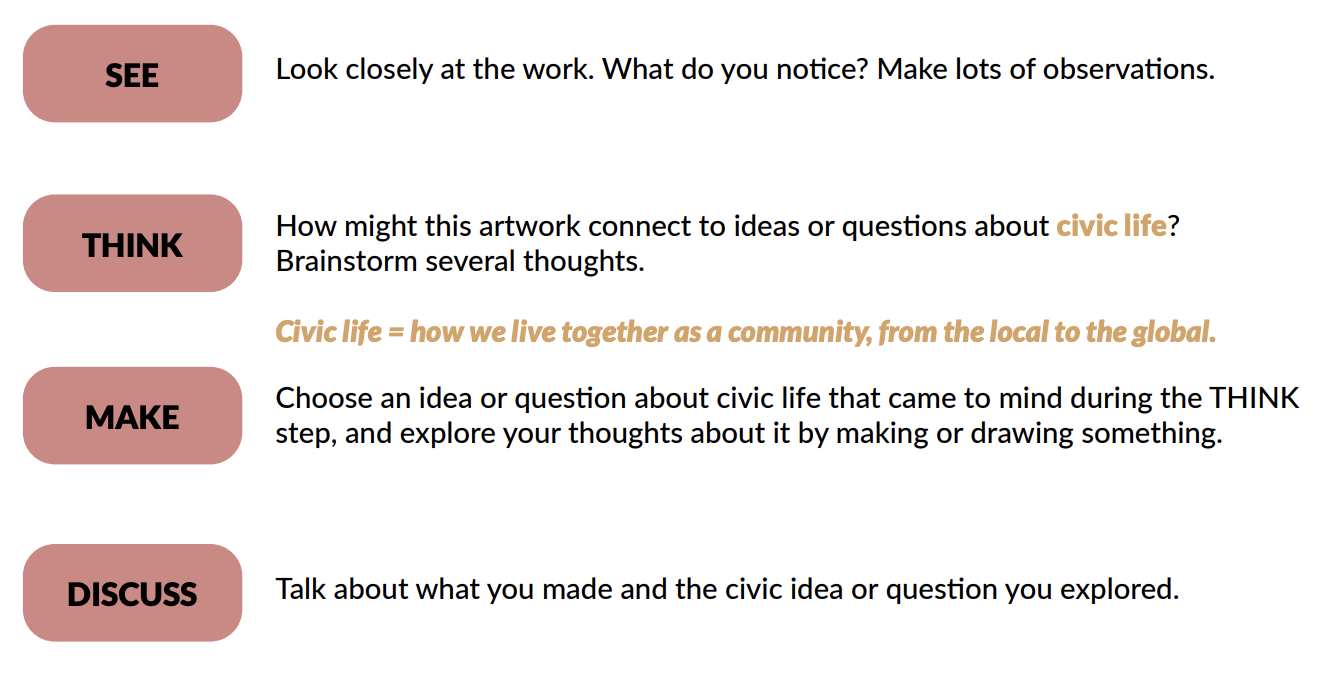
See, Think, Make, Discuss
A routine for thinking about civic art through making.
Prepare
Before you begin this routine, you will need to gather some materials to make something. Paper and pencil are more than enough, but you might also want to consider other materials, perhaps even things that don’t seem like art materials. What about that piece of junk mail you were going to recycle or that can of seltzer whose contents you just emptied into a cup? Feel free to use whatever you have available, even if it seems unconventional.
BEFORE YOU BEGIN
Choosing an Artwork: Before beginning the routine, you will want to select a work of art. Any artwork that can be read through a civic lens works well, whether that reading is aligned with the artist’s intention or is an interpretation you bring to the work. Artworks that could be read through multiple civic lenses, rather than explicitly focusing on one topic, leave a bit more room for interpretation, which may be more generative for student discussions.
Preparing Materials: You will also need to gather some art-making materials before starting the routine. These materials can truly be whatever is at hand. Simple drawing materials are more than enough. You can also consider more unconventional making materials, like aluminum foil, string, tape, recycled materials, or anything else that is lying around. The process of making is more important than the product that is created, so expensive or high quality art materials are not essential. Furthermore, we recommend limiting students to using only one to three types of materials, as creativity is often sparked through limitations.
FACILITATING THE ROUTINE
The purpose of this routine is to help students think critically through making. Art making allows for a multiplicity of meanings to be shared and explored at once, evoking rather than defining interpretations. Making also offers many opportunities to think and express oneself in ways that are often difficult or impossible to articulate in words. You might consider using this routine when you want students to explore emotions around a civic topic or when engaging with a topic that can be difficult to discuss or put into words. If your students need more support during the See step, consider implementing a Viewing Move; extra support for the Think and Discuss steps can be found in the use of a Dialogue Move.
Supporting Making: Keep in mind that making can look many different ways, be done individually or collaboratively, and take vastly different amounts of time. Feel free to leave the making prompt as open ended or as specific as fits your needs. We recommend limiting the time spent on making - you might be surprised with what can be created in only 5 minutes! In fact, limiting the amount of time and materials spent on making can lower the stakes and help students to be more free and take more risks with their expression. To further help lower the anxiety that can often come with sharing artworks, students need not share what they’ve made (although, of course, they are welcome to). Students can focus on sharing their making process and any new thoughts or insights they came to through making rather than the product of their making.
Here are just a few ideas of what making could look like: a drawing, a collage, a small sculpture made of recycled materials, a plan for a larger artwork, a remix of the original artwork, a poem or song lyrics, a short play/skit/dance.
Origins
This thinking routine emerged from the Arts as Civic Commons project. Take a look!
Copyright
© 2019 President and Fellows of Harvard College and Project Zero. This work is licensed under a Creative Commons Attribution-NonCommercial-NoDerivatives 4.0 International License (CC BY-NC-ND). This license allows users to share this work with others, but it cannot be used commercially. To reference this work, please use the following: The “See, Think, Make, Discuss” thinking routine was developed by Project Zero, a research center at the Harvard Graduate School of Education