
Portable Surprise
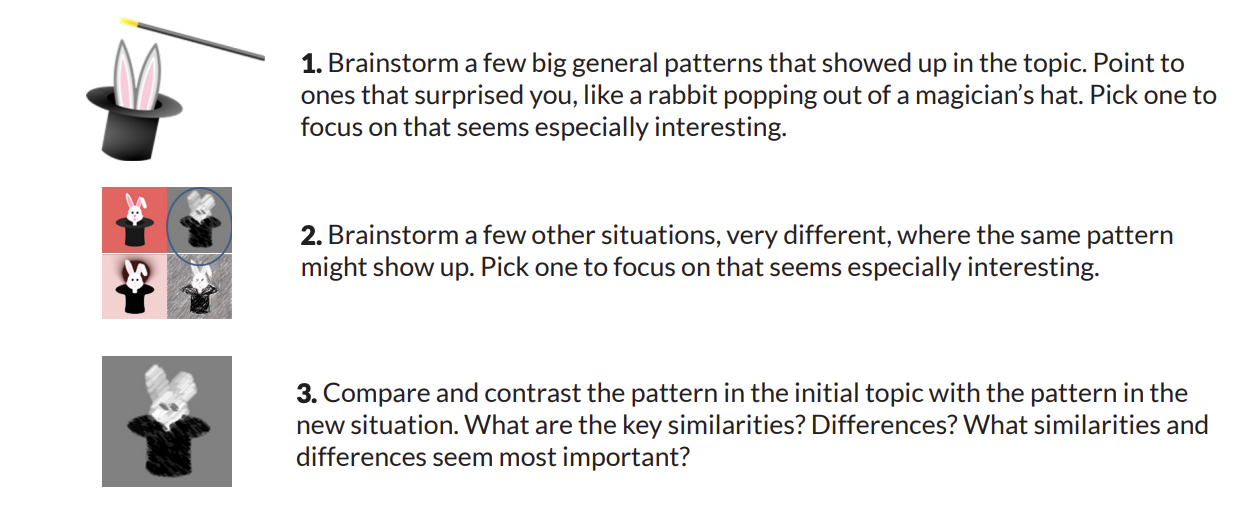
A routine for finding patterns in a topic and similar patterns in very different situations.
(pattern = any generalized relationship across many cases, often with variations, e.g. good guy/bad guy in literature, transformative inventions in history, food webs in ecologies)
PURPOSE
What kind of thinking does this routine encourage?
Abstracting important surprising patterns from a topic and also finding somewhat similar patterns in very different situations and comparing.
How does this help build portable knowledge? The thinking routine makes more portable some of the ideas about the topic itself. And also, the thinking routine cultivates the general habit of seeking portable knowledge.
APPLICATION
When and where can I use it?
Turning to examples mentioned earlier, one can see in global warming a pattern of confusing controversy that also showed up around cigarettes and today around genetically engineered crops. One can extend the concept of food webs in a natural ecology to ask about the food webs of humans today in our complex societies, or prehistorically, or the food webs of pets, or even the “food webs” in an analogical sense in patterns of consumption around product marketing and sales. Or, for a new example, if students are studying nuclear weapons, one can ask what were the “game changer” weapons of other eras, for instance the bow and arrow, and how were the impacts the same and different in a broad sense. Or, to generalize even further, one could explore “game changer” products (like the iPhone) or ideas (like democracy) in the same spirit. How is the pattern of “game changing” similar and different to that of weapons?
LAUNCH
What are some tips for starting and using this routine?
What if students have trouble extracting patterns? Emphasize the idea of surprise. Draw from the students what surprised some of them, at least a little bit. Then what pattern made it surprising? Help and hint a little as you need to.
What if the students have trouble finding other situations that might be similar? Again, help and hint a little as you need to.
What if students want to compare and contrast with a new situation that actually isn’t a very good analogy? It doesn’t have to be a really good analogy. Remember, step 3 invites similarities and differences and an assessment of their importance. You can easily ask at the end: As it turns out, is this a really good analogy or only a so-so analogy? Even so-so analogies can be illuminating, the contrasts as revealing as the similarities!
Can we discuss more than one pattern and connection? By all means, if time allows. One way to get more ideas in play is to have students apply Portable Surprise in small groups, each group picking a favorite analogy to develop. At the end, the groups share a few headlines about their discoveries.
Origins
This thinking routine emerged from the PZ Connect project. Take a look!
Copyright
© 2019 President and Fellows of Harvard College and Project Zero. This work is licensed under a Creative Commons Attribution-NonCommercial-NoDerivatives 4.0 International License (CC BY-NC-ND). This license allows users to share this work with others, but it cannot be used commercially. To reference this work, please use the following: The “Portable Surprise” thinking routine was developed by Project Zero, a research center at the Harvard Graduate School of Education