Playing Around with Roles
PLAYING AROUND WITH ROLES
Engaging young learners in exploring complexity and finding opportunities to make systems better requires perspective taking and empathy. Role playing can be a powerful approach to support learners in taking others’ perspectives when exploring the roles, ideas, and feelings of different characters in a system. Here we offer a few thoughts on how to leverage children’s natural desire to play and how to employ different thinking routines to foster perspective taking and empathy. This tool is intended as a starting point and does not need to be followed step by step or happen all at once. We suggest that points 3-5 below be iterative. Teachers should feel free to adjust this tool to meet their needs and the needs of their students.
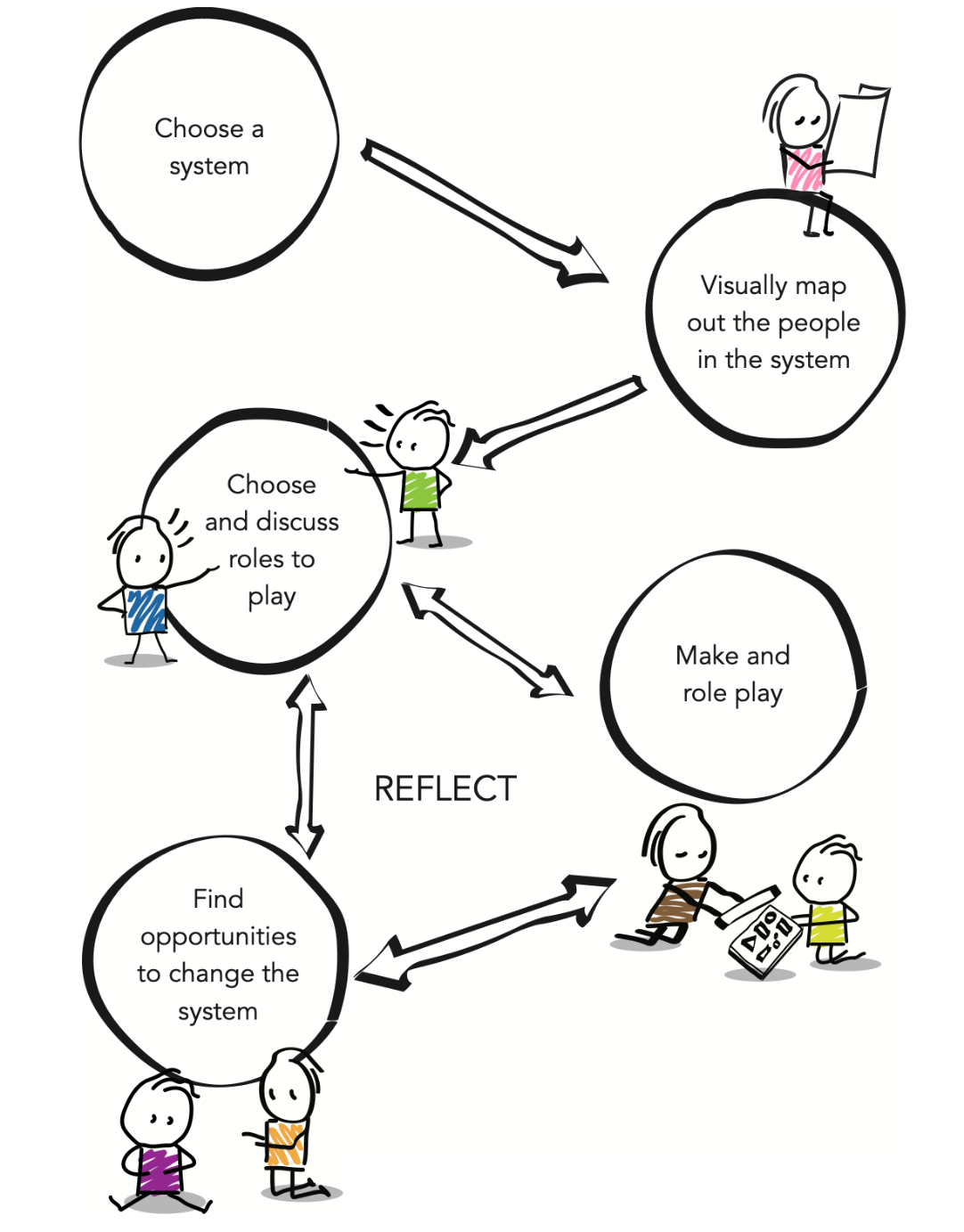
- Choose a system that is familiar to the learners. Children are able to draw from their own experiences to imagine someone else’s experiences and perspectives. Therefore, using a system that is familiar to them can be an effective way to invite their perspective taking and empathy. For example, if your students have daily experiences with public transportation, you might select the local transportation system.
- Visually map the system. Visual representations are helpful for young learners to keep the different parts, members, and interactions of the system in mind and serve as a reference point during their role-play. You can use the Parts, People, Interactions thinking routine or facilitate an open conversation with learners to identify the specific parts, people, and interactions within a particular system. You can also use the Mapping Systems Experiences tool. The important thing is to make it visual. For example, if representing a transportation system, students can draw a transportation hub and visually identify the trains, passengers, conductor, ticket sellers, etc.
- Choose and discuss roles to play. Assign or allow students in small groups to choose a member of the system they will play. In their small groups, they can discuss the different activities, experiences, and perspectives of each individual. For example, they might discuss that passengers usually sit or stand in a train, read a book or sleep, etc. You might ask questions to facilitate the conversation; for example, “where are the passengers headed?” Try to help your students explore the complexity of the different individuals by helping them go beyond superficial characterizations and stereotypes.
- Make and role play. Give students time to create their own props with materials available in the classroom and act out their roles. Provide them with opportunities to guide their own play, but don’t be afraid to offer guidance. You might support their role play by offering other materials and props, such as a conductor’s hat, a newspaper, or train tickets you’ve collected from families. You can offer challenges or puzzles that learners can work out during their play. You can also prompt them to switch roles.
- Find opportunities to change the system. Invite learners to think about how they can change the system to make it better. You can use the Imagine If… thinking routine to help students generate ideas for changing the system. Then, encourage students to incorporate those ideas into their next role play session by changing or adding new roles, making new props, and/or adjusting the ways they interact with each other within the role play. This can be extended to think about how changes can be made in the system in real life.
A note about reflection: Throughout the role play, especially points 3-5 above, engage students in conversations about the thoughts, feelings, and motivations of members in the system. You can use the Think, Feel, Care thinking routine and introduce vocabulary to expand children’s descriptions of what individuals in the system think, feel, and care about. You can use documentation from role-play sessions, diagrams, or other forms of visual representation to capture children’s thinking and expand the play scenario.
This thinking routine emerged from the Early Childhood in Making project. Take a look!