
Places of Agency: How Where We Learn Supports Student Empowerment, Choice, and Freedom
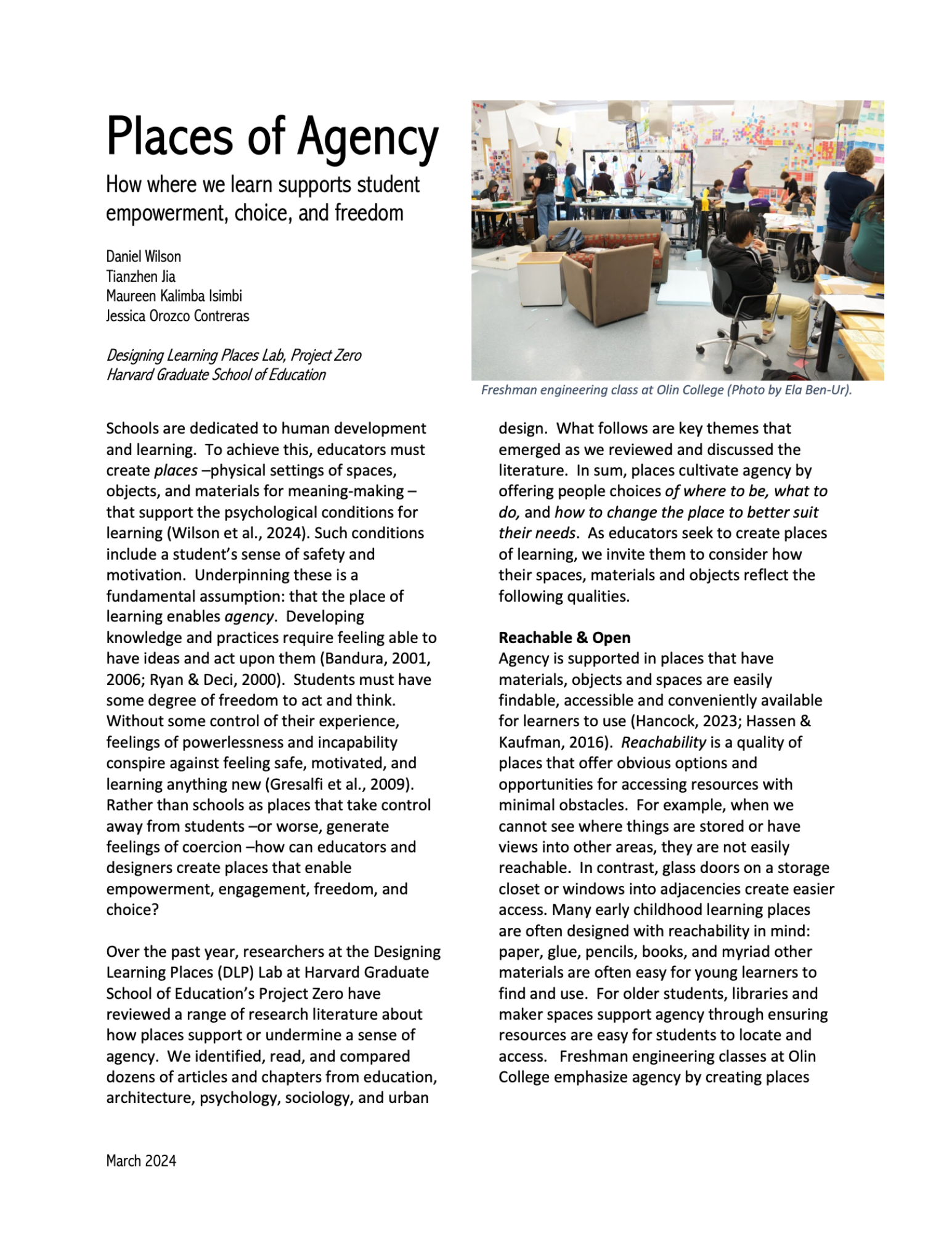
Places of Agency explores how the physical design of learning environments shapes students’ sense of empowerment, motivation, and freedom. Drawing on research from education, psychology, architecture, and urban design, the authors argue that meaningful learning depends not only on pedagogy but also on the qualities of the spaces where learning occurs. The paper identifies three central qualities of “places of agency”: reachable and open, movable and flexible, and varied and adjustable.
Reachable and open spaces provide easy access to materials and clear visibility, reducing barriers and encouraging exploration. Movable and flexible environments enable learners to reconfigure furniture, tools, and layouts to fit evolving needs, fostering ownership and adaptability. Varied and adjustable spaces support diverse sensory and functional experiences, allowing learners to tailor lighting, sound, and seating to their comfort and focus.
The authors conclude that agency arises when physical spaces invite participation, choice, and modification. Yet place alone is not sufficient—its potential is realized only when combined with pedagogical practices that give students genuine opportunities to make decisions about their learning. Ultimately, Places of Agency calls on educators and designers to recognize how thoughtfully crafted environments can empower learners to act, think, and create with autonomy.