
The Place of Learning: Why Where We Learn Matters
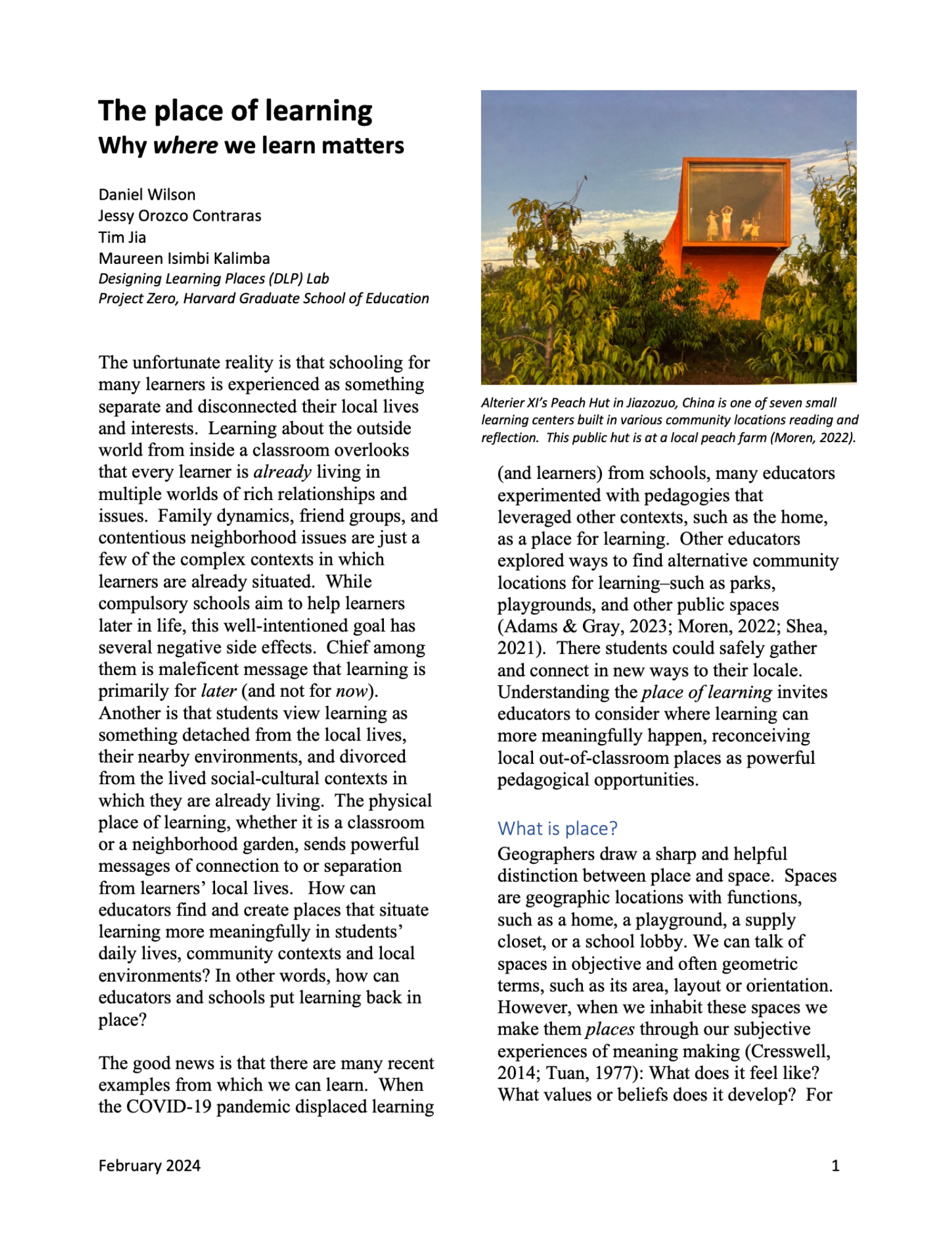
The Place of Learning examines why the physical and social contexts of learning profoundly influence how students engage, connect, and make meaning. Drawing from research in geography, environmental psychology, and education, the authors distinguish between space—a physical location—and place—a space imbued with meaning through lived experience. They argue that learning environments too often disconnect students from their immediate lives, communities, and ecosystems, reinforcing the notion that education is preparation for “later” rather than meaningful “now.”
The paper advances place-based learning as a framework for reconnecting schooling with local contexts. It traces the deep historical roots of learning in place and highlights contemporary examples from schools that integrate community locations, cultural knowledge, and ecological awareness into curricula. Place-based learning, the authors suggest, fosters meaningful learning, ecological literacy, community relationships, and student well-being. They propose four pedagogical “frames” for situating learning: learning in place (changing where learning occurs), of place (studying the significance of a location), from place (drawing transferable insights), and with place (co-creating change with communities). Together, these frames invite educators to design learning that is grounded, relational, and transformative—connecting local understanding with global awareness.