Parts, Purposes, Complexities (For Younger Children)
Looking Closely.
PURPOSE
What kind of thinking does this routine encourage?
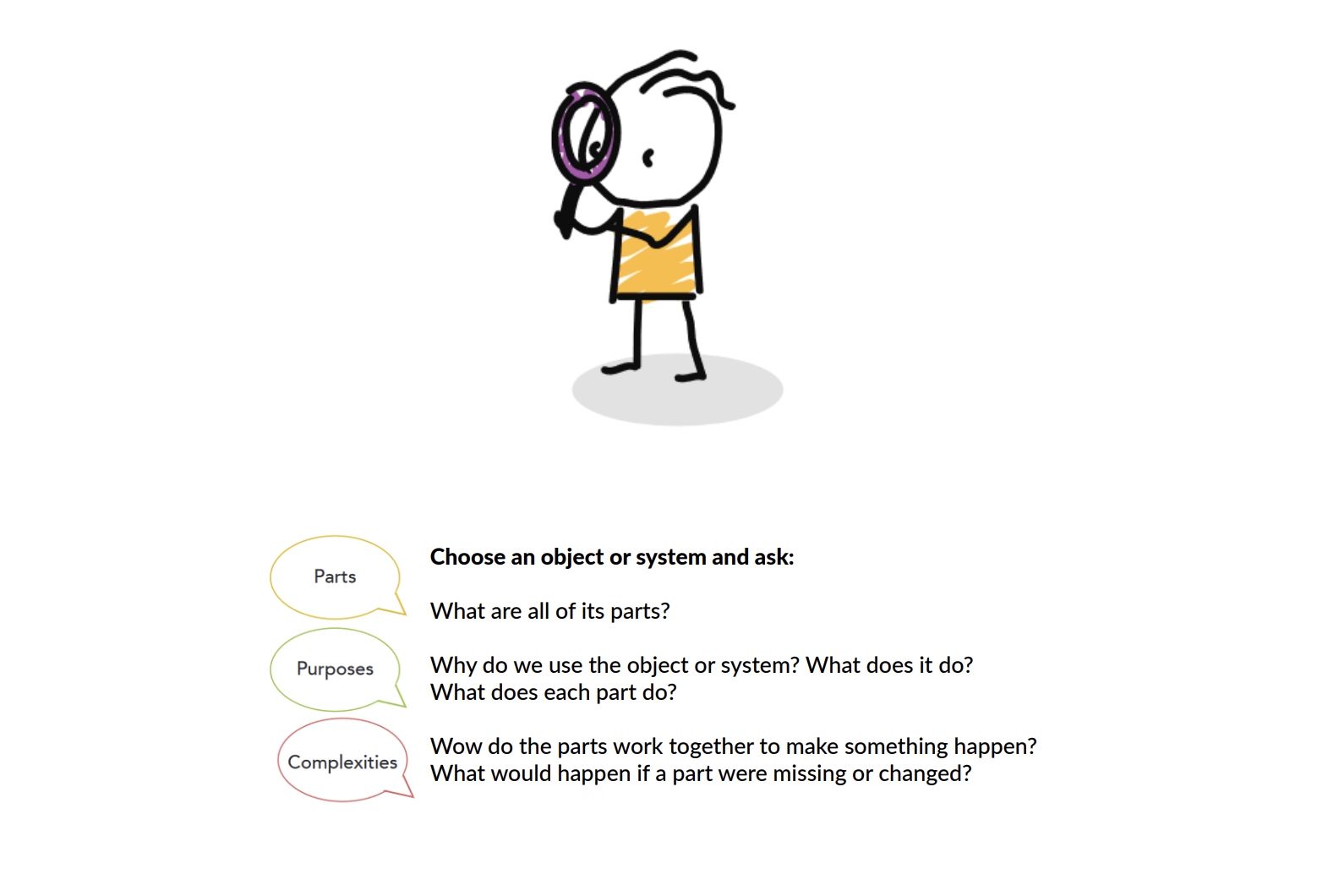
This routine encourages learners to slow down and make careful, detailed observations as they look beyond the obvious features of an object or system and think about how it works. This thinking routine can help foster curiosity as children notice details, ask questions, make connections, and identify topics for future inquiry.
APPLICATION
When and where can I use it?
You can use this thinking routine to explore any object or system. You may choose to introduce the entire routine at once, or you may choose to break it down into parts over multiple occasions.
This routine provides an opportunity for children to make their thinking visible. Children can showtheir thinking through drawings, photos, role play, and/or writing.
If you are using this thinking routine with young learners, consider having them explore an objector a system they have direct experience with. This way, all children can apply and build upontheir prior knowledge in meaningful ways. We suggest you start with objects or systems in yourclassroom or community that students use regularly.
Help children develop their language and literacy skills by encouraging them to work togetherand to discuss what they notice with a partner. Consider creating a class word wall of descriptivelanguage that the class can use and add to over the course of the school year.
To encourage children to deepen their understanding of the parts, purposes, and complexities ofthe object under study, have them take apart the object. Then, repeat the thinking routine whilelooking closely at the separate parts.
You may realize, as you engage with this thinking routine, that the system you have selected ismore complicated or abstract than you originally thought. This is okay. Help students look closelyat the parts that they are interested in, and feel free to help them seek more information by askingeach other, by using books or the internet, or by consulting with community members. It is okay if students have unanswered questions about the system. Consider documenting these questionsto revisit if the opportunity presents itself later on.
Note: This thinking routine is adapted from the Agency by Design Parts, Purposes, Complexities thinking routine.
Origins
This thinking routine emerged from the Agency by Design and Artful Thinking project. Take a look!
Copyright
© 2019 President and Fellows of Harvard College and Project Zero. This work is licensed under a Creative Commons Attribution-NonCommercial-NoDerivatives 4.0 International License (CC BY-NC-ND). This license allows users to share this work with others, but it cannot be used commercially. To reference this work, please use the following: The “Parts, Purposes, Complexities (For Younger Children)” thinking routine was developed by Project Zero, a research center at the Harvard Graduate School of Education